Showing posts with label Theory and Practice. Show all posts

Friday, December 05, 2008

Lesson Method

The Seguin Method

"In every exercise, when the child has recognized the differences between the qualities of the objects, the teacher foxies the idea of this quality with a word. Thus, when the child has many times built and rebuilt the tower of the pink cubes, at an opportune moment the teacher draws near him, and taking the two extreme cubes, the largest and the smallest, and showing them to him, says 'This is large.' 'This is small'. The two words only, large and small, are pronounced several times in succession with strong emphasis and with a very clear pronunciation. "This is large, large, large,"' after which there is a moment's pause. Then the teacher, to see if the child has understood, verifies with the folowing tests: "give me the large one. Give me the small one." Again, "The large one." "Now the small one." "Give me the large one." Then there is another pause. Finally, the teacher, pointing to the objeects in turn asks, "What is this?" The child, if he has learned, replies rightly. "Large." "Small." The teacher then urges the child to repeat the words always more clearly and as accurately as possible. "What is it?" "Large." "What?" "Large."

Education of the Senses

"We may conclude with a general rule for the direction of the education of the senses. The order of procedure should be:

1. Recognition of identities (the pairing of similar objects and the insertion of solid forms into places which fit them)
2. Recognition of contrasts (the presentation of the extremes of a series of objects).
3. Discrimination between objects very similar to one another.

To concentrate the attention of the child upon the sensory stimulus which is acting upon him at a particular moment, it is well, as far as possible, to isolate the sense; for instance, to obtain silence in the room for all the exercises and to blindfold the eyes for those particular exercises which do not relate to the education of the sense of sight."
Both excerpts from "Dr Montessori's Own Handbook", quoted from Natural Structure.

Monday, November 10, 2008

Study and Test-taking Skills

I was thinking about how I always seem to drift during review week and to some extent during exam week. It occurred to me that I could use those weeks as a sort of practicum to teach some study skills. I think this is one thing that Sean is having trouble with in school, partly because of the type of memory he has but also because he never really got much guidance in this from me.

Here are a few links I found on study skills for middle schoolers-through college.
I think perhaps I'll choose a couple of ideas to focus on during each term's end and thus use the reviewing as a sort of practicum.

Here are a few more:

Thursday, October 23, 2008

Setting Sail

I was researching the pros and cons of block scheduling, and liked this Setting Sail in a Waldorf 7th Grade. I realized while looking it over that we don't really do "Main Lessons", but we do something more like "strands" that go through different permutations and link with each other. Does that make any sense?

So here is my tentative list of Strands for my 7th grader -- sorry, the descriptions are sort of vague in places, since this is just a starting point:

The Creed

Thorough study of the Apostles Creed through reading and discussion, with reference to the Catechism and to apologetic source books, and increasing understanding of different religions and their histories and beliefs. Understanding of the compatibility of faith and reason, and how this plays out in what we believe.

The Pauline Year

Read about St Paul, his life and work and thought. .... trace up to Benedict and his declaration of the Pauline Year.


Research Skills

Reading a range of different sources; summarizing; starting to compose simple reports

Composition


Understanding, discussing, retelling a literary tale. ... beginning literary analysis; applied grammar.

Renaissance


Covering the achievements in art, literature, science, architecture, music etc during the period of the Renaissance in Europe. How discoveries led to new discoveries. Side Topics -- history of science, developmental of new artistic and architectural techniques, printing press.

Reformation

Luther, Calvin and others -- the origins of Protestantism, its spread, its effects, the Counter-Reformation. Ignatius, Edmund Campion, Southwell.

Shakespeare

His life and literature, what stories he used (Plutarch, etc) and who he influenced. Some of the history of drama and the theatre.

Lepanto

The battle, its significance, Church history related to the time period, literature. Cervantes, GKC.

Age of Discovery


Mapping, exploration, discovery of the New World. Geographical review and consolidation; mapping skills; some exposure to different cultures in different parts of the world, mostly through a variety of reading.

New World

What the original meso-American civilization and Native American peoples lived like; their first encounters with Europeans. The physical terrain and how it affected the civilizations.
The first explorers, discoverers, pioneers and colonists; their history and their encounters with the indigenous peoples.

Math

Inductive introduction to algebra and geometry, problem-solving creatively, consolidation of skills in basic arithmetic -- particularly fractions and decimal fractions.

Mechanics and Astronomy

Science through biographies of Renaissance and early modern scientists and discoverers, and descriptions of what they discovered. Origins of modern science and its interaction with Faith.

Chemistry and Physics

Basic introduction to Matter, Light, Sound, Motion. Development of a science vocabulary; understanding of physical and chemical processes.

Local Landscape

Local investigation and identification of things peculiar to our environment, plus some of the history of the area -- geographical and social. Seasonal journaling.

Classic Languages

Latin and Greek with some analytical English grammar and vocabulary.

Logic

First elements of logical thinking through formal logic, Venn diagrams, and discussion. Application through composition.

Music

Introduction to piano; exposure to variety of different types of music, particularly Renaissance music.

Art & Architecture

Drawing techniques including perspective, shading. Beginning drafting and design; history of architecture. Work with different media.

Health and the Human Body

The history of anatomy; the structure of the human body; how to draw human forms, sculpture and forms. Respect for life, knowledge and care of person.


Founding of our Nation

Early history of the United States. Focus on biography.

Vocational


Exploration of different skills related to the child's talents, temperament and interests. Examples: Cooking, Cartooning, Woodworking, Science Investigations, Weightlifting, Running, Football, Computer Programming, Story-making, Photography, social interactions, paid jobs around the house, managing money.

Where we seem to differ from standard units or main lesson blocks is that we weave these in and out in different ways on different days. I've always found it very difficult to categorize learning into subjects, yet I do tend to plan in subject boxes. But I see that I am really planning more in terms of "topics" that are connected to each other across the subject compartments.

Since my other kids are so young, it's very easy to just let them come along for the ride and do what Kieron is doing, except on an extremely simple level.

On a given day, I am realizing, we don't do "History, Math, Latin, Logic" , Instead, we tend to turn from a read aloud on Shakespeare to a retelling of Hamlet to a reading on European history in the 16th century, to some mapping, etc.

I think I have been influenced by Charlotte Mason who did a combination of "integration" with a bunch of short lessons. She didn't really go for unit studies or "concentration schemes" as they were known back then, but she did believe that knowledge interlinked and that a sequential, connected curriculum was important.

Anyway, just a few half-thoughts. Maybe now that I see this pattern I will have an easier time keeping records. Looking back at this week I can see that we were heavier on Shakespeare, studied European history and early science just a bit, and skimped on religion .... etc.

I have a Google Doc where I'm revising the basic list as we move through the year: Main Lessons for Year Seven.

Also, here is the link list for block scheduling. It's mostly of interest to public schools who have challenges changing their time format. In a homeschool you can do whatever seems to work. Personally, we like to vary, but we tend to operate in short lessons (15-20 minutes) for most assignments. If the child is still interested we can always extend the time and of course crafts and projects and read-alouds need longer periods, but 15+ minutes usually seems like enough to do a complete lesson in math or Latin or catechesis, with a few minutes of independent work afterwards.

Thursday, September 04, 2008

Details of Mondays

I'm slowly going through the days of the week and trying to list out what "belongs" to that day, for the Year 7 and Year 1 children.

So here is Monday. ... which Kieron (Year 7) and I agreed ought to be the lightest of the days provided that he mostly finished his work the week before.

Most of the things on the list only take 5-10 minutes and most are review/reinforcement type activities.

Is this level of detail necessary? No, it's not. When I had a whole handful in the homeschool, and a baby in arms, I simply did not lay things out so precisely.

Is it helpful? In many ways it is, for someone like me who gets stuck on retrieval. In a book I read by CS Lewis, he spoke of how the ancients tended to divide things into threes -- there was always a "middle ground" between one thing and another. In Catholic thinking, you have "proximate" (close view), "remote" (the big picture or distant goal) and "mediate"(the in between stage). I usually have the most trouble with the middle ground.... that is, how to get from the big picture to the details of daily life, and vice versa. So a lot of this planning I do is about translating my overall goals into something I can actually sit down and work on in daily life.

Clear as mud? LOL. Homeschooling is as simple as a parent, a child, and whatever they are focusing on.... a sort of triangle. All you really need are books, paper, writing and/or drawing implements, the concrete details of daily life, plus a sort of "narrative" -- ongoing conversation and rhythm of relationship, that makes meaning of the concrete details. And time to play and think and explore.

The castle is there on the form to remind me of that -- since I'm a visual right-brained type : ). But I wanted to write it out, too.

Thursday, July 10, 2008

B is for Balance, Basics, Building

A bit more on Plan B. I mentioned it before as an alternative to getting locked into plans. I wanted to talk about it a bit more because it's perfectly possible that people could read this blog and think that all these forms look incredibly complex and that our daily structure is that way, too.

Voltaire said that "the best is the enemy of the good." Charlotte Mason quoted that.... making the point that we can paralyze or wear ourselves out in a quest for perfection.

I think part of what I think of as "Plan B" is an antidote to this (I almost typed "Plan Be" and maybe that was a subconscious slip).

I think planning can be a good thing. St. Ignatius, in his Spiritual Exercises, structured things very carefully, trying to "scaffold" a retreatant's attempts to make progress in spiritual things. He wasn't trying to replace grace, but to support its workings by providing an order and goals.

But I, personally, have to watch out that my plans don't replace the workings of learning; that what ought to be a scaffold becomes something like an exoskeleton or a stockade, closing us in.

So that's where the "Plan Be" comes in for me -- it is a reality check, the "bottom line" of how I want my family to function. In homeschooling for quite a few years, I have seen that what really WORKED in the long run was the basic habits and traditions in my family. The conversations, the reading, the music, the nature expeditions, the reflections and examens and "family language" type thing that builds bonds (hmm, two more "B's" there)

Whether we got through X math book, or purchased Y curriculum, really mattered a lot less in the big picture than these basic family "Ways".

So when I'm feeling that we are getting either over-stuffed with "too much", too many things flying at us in the way of subjects, activities, plans--- or else that "starved" feeling of envying/feeling wistful about what other homeschools are accomplishing or purchasing.... then I return to those Plan B for "basics, bottom line, being" that help us restore our balance (one more B : )).

The planning does seem to help -- I am one of those who have to engage with something to make it work, and planning is for me a fun way of engaging. But I've managed before without much planning, because that part of it isn't really the essence. The essence is a book, a child, a parent, maybe some paper and a pen. Remembering that helps me use the planning as enrichment, as support, rather than having the planning take over and stand in the way.

It really is a practical coping device, so that's why I'm mentioning it here.

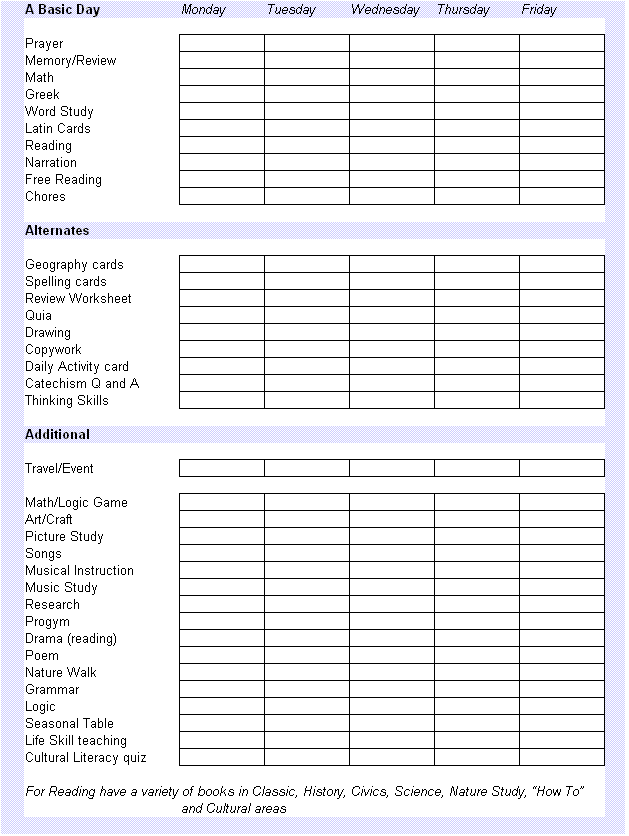
The gif is a basic weekly checklist which I use sometimes when I want to simplify things, and here is the doc Weekly Checklist.

Friday, July 04, 2008

Analyzing and Synthesizing

I found this neat post Wrestling with Homer at a blog I hadn't seen before, Fanning the Flames.

I am sitting here with a pile of books:

Classical Writing Aesop, Homer and Diogenes

PLUS Connecting with History (a Catholic resource somewhat similar to Tapestry of Grace, designed by two internet friends of mine from way back)

Oh, yes, and Composition in the Classical Tradition.

I think I've mentioned before that I have a lot of trouble using any "teacher" resources. The basic rule of thumb is: If I can't simply hand it to my kid, I can't use it. That is why I end up using workbooks and living books more than almost anything. My preferred approach to education is the tutoring model -- the kid works with the material, and I help him by (sometimes) introducing the lesson and (sometimes) helping him solve difficulties and (sometimes) correcting or helping him go over his independent work. Books and workbooks lend themselves to this, while teacher-intensive resources generally don't.

These resources are so good, however, that I would like to make them work....somehow... so that is why I am sitting here with this pile. They are teacher resources, yet the methods are high-quality and so are the related philosophy and resources.

We are not studying ancient history this year, so I didn't dig out Connecting with History because of the material. Rather, I saw it with the other resources : ) plus I wanted to revisit their method, summarized here. It is somewhat inspired by the Ignatian method, which I talked about here.

Classical Writing advocates a "routine" for Analysis and Imitation. I wrote a bit about that here.

From Classical Writing: Models

It seems to me, firstly, that what a man seeks through his education is to get to know himself and the world; next, that for this knowledge it is before all things necessary that he acquaint himself with the best that has been thought and said in the world; finally, that of this (best), the classics of Greece and Rome form a very chief portion and the portion most entirely satisfactory.
~ Matthew Arnold

Yesterday it occurred to me that I have been having trouble using resources like Classical Writing because I am focusing on the "teaching" part of the thing; when in actual fact, I have always had much more success focusing on a source or model, and then doing the teaching "by the way".

It's a bit difficult to explain, but the way the Ignatian educators approached literary models was to focus on the models themselves. They did it in two ways -- one was to use the literary model as an example of a precept. This was the "deductive" approach. Another was to focus on the model, and then use it as an example of a given precept of style. This was called the "inductive" approach.

This is the analysis component of the literary lesson. The "imitation" followed. It was almost an enactment of what had been learned. The lessons have often been compared to "practicums" -- putting knowledge into practice. But the point I am trying, not very well, to express, is that the model itself was the key thing. As Charlotte Mason puts it in a different context, the object is outside of ourselves.

I am not sure why, but I think that this is the source of my past difficulty using progym activities, though I am so in love with the idea. I think I was approaching it too much from the "improvement" side of things, and so I was bogged down in an internal contradiction.

So I'm approaching planning the progym from a different perspective, in light of that. I'll try to be clearer and more specific some other time. Right now I just wanted to write that out in order to see if I could ;-).

Thursday, July 03, 2008

What's Next

I love devising forms. So much so that I am having trouble going on to the next stage of planning. This would be the process of planning/writing out resources, where the ideas matter more than the structure ;-).

What I'm trying to do now is walk through the first "week" or so in my imagination, trying to get a big picture of what habits to establish and method to follow. Sounds vague, I guess! I'll try to be more specific, later on. But I got the idea from Katie of being very detailed in the plans for my first week or so -- listing chores, EVERYTHING I can think of -- and keeping it on a clipboard so that I can:

(1) remember what I'd planned and
(2) see for myself what's unrealistic, what will be harder than I expected and therefore will take time, and
(3) memorize the routine (very difficult for me -- I have a very slow physical memory -- I can mentally memorize FAST but "walk-through" muscle memory is very weak in me, which is why I was never good at sports or cooking or anything where you have to master a physical process and think actively while doing it)

Anyway, thinking about this has already helped somewhat, even though it is so vague. For instance, knowing that I want to focus on reading aloud to the little ones and the "outdoors" life, I am already almost unconsciously finding ways to fit these things more intentionally into our present-day-life. Intentional and unconscious sound like opposites but they aren't quite, at least for me.

For now, I am listing things that I want to make sure I include. I am going to start a binder just for that. I may even do the Avilian Method thing where I physically put every worksheet, assignment idea and resource sheet IN the binder in sequential order. (I am not using many worksheets this year, but I can at least put a blank piece of paper with the proposed assignment on top).

I can't imagine having to do this every week for all year and I don't think it would be necessary but I think it may be very helpful indeed in getting started on good habits (for myself and indirectly for the kids).

Still wondering what I'm talking about? (especially since Andrea Chen's great Avilian pages aren't always available for viewing on the geocities site?) I'll try to write out what I come up with.

Thursday, June 05, 2008

Time to Breathe

So far, you couldn't tell from reading all this that I profess to be a sort of unschooler. Well, there it is. I find it easier to have things thought out ahead of time, and be flexible about the approach. I should remind myself though, now, that I am trying to structure things minimally. I am trying to keep the actual coursework down to 27 x 4 which is basically 110 days. That gives us 35 days for enrichment/variety, and about 35 days for review and exams.

In many ways I find it useful to divide things into three components. I will try to write this out better and perhaps put it on my main blog. Maybe it's a bit similar to Charlotte Mason's: An atmosphere, a discipline, a life.

  • One section I consider to be "disciplina" (instruction). Here is where I fit the systematic skills or "tools" -- phonics in the early years, Latin and math and grammar in the later years.
  • One section is the "inventio" (discovery, exploration). Here I focus on ideas and "enculturation". This can be done in a variety of ways -- unit studies, rabbit trails, "themes". Here is where I usually put history, literature, geography, science, with religion as the head of them all. Here is where I emphasize the "science of relations" -- making connections, thinking philosophically.
  • The final section is basic life skills -- character formation, practical "know how" and also development in areas of particular strength and "gifting". This is where my unschooling probably comes in the most -- my parenting style and the childrens' vocational aptitudes and directions.
Obviously these overlap in many ways, but thinking in the three categories helps me keep my thought processes ordered, and balance out my approach. I notice that we get demoralized if I rely too much on the first approach, confused and scattered if I rely too much on the second, and we drift and get too lax if I stay too closely with the third. Really though, I think the foundational one is the third, and it is possible to meet most or all goals this way. That is where I am a much more comprehensive unschooler in theory, though not always in practice.

Just a few thoughts, very random. ... more like notes for something I am trying to think out carefully enough to actually write up.

All three of the areas must be permeated with space. ...leisure, down time. Breathing in, breathing out. I am still pondering how to make that work in my homeschool. As with any home, down time here seems to get quickly filled with squabbling, desire for screen time, and discontent. With noise and clutter rather than with quiet radiance. But yet, this quote seems to apply:

"It is only framed in space that beauty blooms. Only in space are events and objects and people unique and significant-- and therefore beautiful. A tree has significance if one sees it against the empty face of sky. A note in music gains significance from the silences on either side... Even small and casual things take on significance if they are washed in space."

Sunday, December 02, 2007

About the Dysgraphia

Here is some more information, and some helps.
Here's another site.
(I don't know if Kieron actually has the underlying condition, but he certainly has the symptoms. We have worked on this through the years but it seems to be hitting particularly hard this year, partly I suppose since the gap between the cognitive and the mechanical is widening).

Some strategies listed:

1. Encourage students to outline their thoughts. It is important to get the main ideas down on paper without having to struggle with the details of spelling, punctuation, etc

2. Have students draw a picture of a thought for each paragraph.

3. Have students dictate their ideas into a tape recorder and then listen and write them down later.

4. Have them practice keyboarding skills. It may be difficult at first, but after they have learned the pattern of the keys, typing will be faster and clearer than handwriting.

5. Have a computer available for them to organize information and check spelling. Even if their keyboarding skills aren't great, a computer can help with the details.

6. Have them continue practicing handwriting. There will be times throughout a student's life that they will need to be able to write things down and maybe even share their handwriting with others. It will continue to improve as long as the student keeps working at it.

7. Encourage student to talk aloud as they write. This may provide valuable auditory feedback.

8. Allow more time for written tasks including note-taking, copying, and tests.

9. Outline the particular demands of the course assignments/continuous assessment; exams, computer literacy etc. so that likely problems can be foreseen.

10. Give and allow students to begin projects or assignments early.


I'm going to try a few of those and see how they work for him. Then I will move on to some more (there were a LOT listed).

Before I looked it up, I was thinking that I would have him do some review work every day in writing. I noticed that when the math is easy, for example, he has a lot less trouble writing (less reversals, less shaky writing, less dawdling and chewing his pencil) than when its at his level of challenge.

So I was thinking that I ought to simply switch to doing most of his work orally, then have him either:

  • Do a bit of written work at an easier level (from last year's math or from earlier in this year)
  • Copy out a "fair copy" of the work I've written down for him.
  • Have him do math copywork.

I can do the same with spelling... use the earlier spelling words for handwriting remediation, then work with him on the more difficult words.

Same with the progym. As far as the progym goes, the dysgraphia sites say it is important to be allowed to outline and order thoughts at your level of ability rather than your level of mechanical competence. Of course, I can't STOP Kieron from ordering his thoughts all the time, whether I'm teaching this skill or not. But CM/classical methods like narration and the progym will allow easily for this.

Also, on the occupational therapy front -- the crafts will help. Fortunately, he loves crafts.

And I am going to try to have a "warm up" period before we sit down to work, where he does some of the Brain Gym type exercises.

So that is the plan for this week.

Saturday, December 01, 2007

Dysgraphia

I guess Kieron's issue has a name: see Eide Neurolearning: Slow Handwriting.

Here is another article on Sensory-Motor Dysgraphia.

It looks like the coping mechanisms right now are occupational therapy to address sensory-motor issues, alongside of keyboard use to keep the child progressing in higher level skills like paragraph revising, etc.

Friday, November 30, 2007

Checklist of Priorities

I planned this out while I was in the car yesterday and typed it today.


We have been so busy recently, with appointments every day, and the first effect is usually to clutter my mind and make it difficult to stay on task and separate high priority from "would be nice" or "important but not urgent".

It looks very structured, I suppose. Sigh...

I guess in effect it is a bit like the "Robinson Curriculum"


I didn't write it down on the sheet, but there is always the option to drop everything and just follow a trail or play games or read for a day or so.... in other words, take one of the Occasional options and just run with it.

Wednesday, November 28, 2007

Day 63

Another minimal day: but I'm rather proud we did anything at all. Clare had an orthodontist appointment at 8:15, which meant we had to be out of the house by just after 7 am and did not get home till close to noon.

I told the boys that we really had better do a bit of math at least, so they both did math; Sean did Greek and Vocabulary and the Latin cards; and Kieron did handwriting and another daily activity card (#63).

Sean has been having an easier time with the math (maybe because of the break?) He has been doing a weight-lifting routine with his dad.

I read Inkheart during the Thanksgiving break, and yesterday and today read a book called Super Reading Secrets. It was one of those dime sales at the library, and I found it at the back of one of our bookshelves when I was helping Clare look for Post Captain (she is on a Patrick O'Brian reading tear). It is actually more substantial than it looks on the surface. I am already quite a fast reader, too fast in some ways. But this had some of the same study and reading techniques that you find in How to Read a Book, only expressed in more "popular" basic language. While I was reading it I rediscovered how I managed to get adequate grades in several classes which I barely studied for. I have a very quick memory (my dad has the same trait), to the point where I can memorize my credit card number in about 2 minutes and retain it permanently along with expiration date and code on the back (yep, just checked). I only have to dial in a phone number 2 or 3 times, and it's part of my longterm memory. And I am a fast reader. I can get the gist of a book in only a few minutes. See, that is not the same thing as really learning something, but it certainly serves its purpose at times.

Not writing this to boast in the least; but I am thinking that this is something I learned accidentally, partly out of necessity (being lazy and disorganized in my younger days) and it could probably be learned intentionally for better motives. So this is what the book led me to ponder -- I wish it weren't so ...gaudily colored and ....based on a gimmick -- I would have Sean read it for the study skills information, but I don't want him to get the notion it is necessary or desirable to read a page in 3 seconds.

Sunday, November 11, 2007

Review Schedule

Day One:

  • Math
  • Religion
  • Literature
Day Two:

  • Language Arts
  • History
  • Geography

Day Three:


  • Logic
  • Science
  • Nature Study
  • Art


(These "days" will look different for different kids. I will try to do Kieron's review on M/T/W. Sean won't be here during those days. He will be here next week, but we will have various things going on, so his review is partly taking place this week (hopefully ---) and then I'll try to tie things up on Tuesday of next week. But I don't have high hopes; we may have to extend his till Monday after Thanksgiving, or just carry over altogether.)

For the structure of these days, I am thinking:

  • Something to Love
  • Something to Do
  • Something to Think About
(or Hands Head Heart)

I am trying to plan up some sort of checklist for this. Of course!

Since it is his first time at this, I'm envisioning it as more of a "recollecting" time.... a time to sit together and reinforce old connections, and make some new ones. "Here's the story of the Great Fire ..... do you remember that? What do you remember?" -- like an interactive interview.

We've done exams before a la CM, with my older set, though never entirely to my satisfaction. I think that is part of the reason we didn't keep up with them consistently..... like an examination of conscience, an examination is revelatory, and that is uncomfortable. It works better for both if you think of them as an entrance, a step into a new place. I am trying to acknowledge ahead of time that I won't be satisfied, that I will find gaps in expression and understanding, and that this is valuable knowledge in itself, worthwhile for the future.

Charlotte Mason emphasized that her exams weren't meant to find out what the students DON'T know, but what they DO know. Exams were also a key element in the Ignatian classical system. With them, as I understand it, the emphasis was less on affirmation and more on accountability. But please realize that these are not dichotomies -- one does not exclude the other. Charlotte Mason did emphasize accountability, on a continuum that looked different at a higher level than it did at an elementary level. The Ignatian schools were secondary/tertiary institutions. There are always going to be, very appropriately, more exterior expectations for a young adult than for a child.

A few more things to consider (I'm adding them on as I think of them):

  • Collect and organize all the photos of his projects. See if he wants to caption them or discuss/narrate them.
  • Take photos of key pages of his various workbooks.
  • Devise a checklist that shows what he has mastered, what is emerging, and what is still not there. (this is special-educationalese, but I've found it useful -- if you want to wade through this bulky pdf Kindergarten Readiness Initiative, there is an example there).
  • Use some of these portfolio checklists.
  • Ask him to list or describe his informal learning or favorite times from the past couple of months.
  • Music Game? (play first few notes and ask him to ID the song or piece -- probably not this term, but maybe next time)
  • Make index cards or notebook pages that will serve as "fact sheets" -- summaries of various processes, or facts, or whatever. An alternative would be posters.

Sunday, October 14, 2007

Learning to Read --LD

I am stuck on teaching reading to Aidan using 100EZ lessons. He has been able to identify letters by their sounds for a couple of years now but is not getting blending. Part of this, I realize, is because he isn't segmenting sounds or being able to put them together again. So when I sound out "d-o-g" it has nothing in common to him with "dog". It might as well be "man on the moon".

So I'm reading different books trying to figure out ways to get him comfortable with decoding and blending. Here are some resources I found this weekend:

Montessori Mom -- Learning to Read.
--Lots of good information about the pink cards and how to use them. One advantage for this approach with Aidan is that (1) he needs lots of repetition (2) he loves doing things he can do by himself.

Some ideas for Teaching Blending and Decoding
There are some visuals for phonics manipulatives here.

Here is some information on teaching LD students Phonological Skills.
Aidan has been able to recognize rhyme and generate it for a long long time -- probably because of the ongoing music immersion in this house. But there's a step from there to being able to produce it on call. With him, there is a big step between producing something spontaneously, and being able to produce it on call. This is showing up in all different areas of his life.

This site does give a progression for teaching to discern broken-up words, which is something Aidan has gotten stuck on both in 100EZ and in Reading Reflex.

(A thought! Get Aidan's SLP involved in this -- it does seem like an aspect of speech and langauge therapy and most therapists seem to settle in more productively when they have something concrete to work on -- probably because unavoidably, they know the therapy better than the individual child).

Finally, I am thinking that teaching the signing alphabet might help him segment. When he was struggling to learn to talk, he made huge strides once I figured out a "combination" approach. He had DK-type realistic picture books which he loved. I found that pointing to the picture and slooowlly, emphatically saying the word, and then talking about it (because his receptive skills were way above his expressive ones) was effective, and so was signing the word and saying it slowly at the same time. After a while he took off on verbalizing and I dropped the picture and sign talk because they became cumbersome. But thinking about that, maybe writing out the letters, signing them, laying down cards and so on might help him in the same way.

Tuesday, October 02, 2007

Day 26

Sean got the basics done: Algebra, Henle Latin, Greek, Vocabulary. Then he read Prentice Hall Earth Science and he is also continuing to read Lamb's Shakespeare. We started reviewing ID of countries in North America. That part goes easily.

Kieron did things a bit differently today. I had him do an online spelling test, and a multiplication speed drill (he is MUCH faster and more automatic than last year). Then he did a couple of multiplication games online. I worked with him on countries of North America too.

We are sort of tight on time because Sean and Aidan have therapy appointments down in town in the early afternoon.

To do: Think about spelling with Kieron, and the writing program with both of them. Also, some Kolbe paperwork.

Aidan and Paddy did a bit of HWT with the letterforms. I read bits of the first My Book Shelf to Paddy yesterday and it went well. I also read a whole pile of board books to Aidan. I ccan count that as math because several of them were shapes and counting. I notice that Aidan has a very auditory approach but picks up on sounds more than meanings. He loves the rhyming books. If I could invent a reading curriculum for him, it would be a bunch of separate (and nicely, not stupidly, illustrated) nursery rhymes in the form of board books, and flashcards to go along.

Nota Bene: In general, this day is a bit too loose for my comfort level but much of that can be attributed to me not prepping things ahead of time. The day goes so much more smoothly when I do spend a few minutes setting up a bit MORE than is needed. Also, I have to admit that I typically stop being thrilled about the plans by about this time and so it may be needed to plan some variety just for MOM's sake.

Another thought -- a slack-off or interlude might just be part of the normal course of things and maybe trying to force through it leads to burnout? Just occurred to me.

Monday, October 01, 2007

a bit more on progym

So then, after all the informal writing experience I talked about in my last post, I became enthused about the progym. I heard about it on my classical list and it was affinity at first hearing -- which is odd for me -- usually I dislike new things at first sight. But the progym seemed like a way to flesh out written narration and make it more understandable to my kids, and for me, to lead them step by step from simple narrations to the more complex writing that Charlotte Mason recommends in the upper grades.

The progym usually starts with the simple fable -- usually Aesop. I skipped that. My kids were a bit too old for fables by then.... ages 12, 13, and 15. I started them into narrative -- the first assignment was to retell the poem of King Bruce and the Spider in narrative prose. I wish I knew where the results were because they were all quite charming. They each told the story in a different way. My kids are notoriously resistant to new ideas, but this one seemed to work for them.

The next assignment we did was to take one of the stories of Alexander the Great, one where he would not eat food if his soldiers were starving. (I can't find it online at the moment). They were supposed to condense it first, then expand it.

Condensing is a useful skill which appears in the later progym, where a story will appear in summary to illustrate a point or lead into one (induction or deduction).

Expanding is done more thoroughly in progym like description, and also is one of the preparations for later exercises in expanding upon a topic.

They particularly did well on the expanding one and it was fascinating to compare results and see how each child according to temperament brought out different aspects of the story -- one son focused on the physical and visual details of the battle-weariness and the blazing sun, another had the drama be largely an intellectual and moral one, and another described the emotions of Alexander and the soldiers very vividly.

At this point I stopped doing the progym with the group -- I think that was when Paddy was born and his stay in the NICU and followup issues took up all my energy. Later Liam, my oldest, proceeded through Frank D'Angelo's Composition in the Classical Tradition by himself (caveat: this is a worthwhile book but not one to simply hand to a kid because there are lots of rather sordid examples concerning child abuse or marital discord -- taken from newspapers -- I think dAngelo must have written the book for law students in college. I would write out assignments for him based on the book, and later, I whited out all the objectionable articles so he could use the book on his own without getting discouraged by all the dysfunction).

Later I got Lene Jaqua and Tracey Gustilo's Classical Writing: Aesop -- I wrote a review for it here. I used the program for Sean and Kieron, who were then 7 and 10. Kieron wasn't writing well yet, so I would take his narrations from dictation and then type them in. I got some excellent narrations from him with beautiful language. His oral narrations are still very good, to this day, so maybe that early grounding was helpful. Sean would do his own, but he was at that age when fables bring out the Pert or Dialectic in a young preteen. He loved to criticize them, write them out and change the message, which sort of defeated the purpose. Or so I thought. Anyway, after about half a year we let it drop in favor of other things.

I think this time around I will approach it more like I approached it with the older set. Partly because the kids are older now, and partly because things seem to go better if I do them my own way rather than trying to do it just like it is written in the book. I still like the CW series for reference and ideas. It's my favorite progym resource of the ones I've seen for the younger set.

Sunday, September 30, 2007

Starting to plan the progym

Short learning log note:

  • Lamb's Tales of Shakespeare must have "worked" for Sean, because he has been reading it all this weekend.
  • Kieron heard me reading Tigger is Unbounced to Paddy and this inspired him to get out Complete Winnie the Pooh Tales which he is now rereading. He wants me to read it to Paddy -- well, it's certainly something to think about.
  • I got out Childrens' Book of Virtues and Moral Compass because I do think Paddy's about at that stage.

-------------

Now about planning:

I have gotten out all my progym and writer's books. This is Aphthonius's Progymnasmata, which is actually a nice summary -- it's the one I used for my older set since none of the progym books were out yet at that time. More about that later.

Also, here is Melissa Wiley about Bravewriter
and Mother Crone: Praise for Bravewriter

I don't have Julie's Bravewriter program, but I do like her Lifestyle principles.

I stumbled upon similar ones by trial and error with my older set. When they were younger, the only writing programs out there for homeschoolers were ones that I did not like. They all seemed artificial to me. Bravewriter was obviously not out back then. I tried a couple of highly recommended composition programs with my oldest, Liam, who is now 21. He was not very impressed, and since he was usually quite fair-minded about his academics, that was a signal to me to drop them quickly. I'm very glad in retrospect I trusted my instincts on this.

I didn't even try any of these standard curricula with Brendan or Clare, who are now 19 and 17. By that time I'd heard of Charlotte Mason and her methods seemed much more compatible with how I wanted to do things.

I had learned to write by copywork and storywriting and little nature writings I did in the summers when I was very young. I liked to make little books which I sewed or stapled together and decorated. When I was very little, my mom read to me a lot and traced out letters for me to copy until I could write on my own. So that's basically how I did it with my kids. They narrated -- not much, but a bit. They did copywork; again, not much, but a bit. They made maps and scrawled little stories on index cards, or sometimes rolled papers and drawings up into scrolls. They played pretend games by the hour and sometimes audiotaped or videotaped their plays.

I wrote down their stories or journals, sometimes, or labeled their pictures, and collected their work into binders. Brendan and Clare gained fluency in reading by telling me stories that I would type, then have them read back to me. As they got older, they kept their own notebooks and labeled their own pictures. All this never seemed like "enough", but somehow, all my older kids became effective writers.

At some point Brendan seemed "stuck" in his writing. He was at a perfectionist age and had just transitioned from all-caps to a legible italics, but he wasn't yet fluent. Liam had become more interested in serious academics, and was writing a few papers for his "studies", but was no longer doing much creative writing. So I started a daily "free writing" -- we'd all gather for 20 minutes before lunch, and the pre-readers could draw. Even I had to write during this time. It was time that was difficult for me to spare, since Aidan was a medically high needs toddler and I was pregnant with Paddy, but I thought it was important to be there too, participating, not skipping down the hall to fold the laundry.

I also had several "writer" type books around the house from my college days. I strewed these and the kids picked them up and read them, at least some of them. The feedback I got back later was that they often disagreed with the writer's advice, but still, these books gave the kids a chance to "converse" mentally with a writing teacher, and pick and choose what they wanted to try out. The authors who write these "writer's manuals" do have their peculiarities and flaws like everyone else of course, but they don't patronize the young writer quite as much as the standard children's textbook on how to write. I don't think it's necessary to read any of these types of books, and authors like Flannery O'Connor will tell you it could be dangerous, but at least the kids have the freedom to pick and choose their "teachers" here.

Eventually, the free writing period was dropped because it was no longer necessary. From there, all the kids embarked on abundant writing -- opinion pieces, journalling, stories, and creative "newspapers". They haven't looked back. All have their own "style" and their own particular strengths.

It was right after this "free writing" interim in our lives that I started experimenting with the progym. I am sketching out all the things that came before, because I do think the progym ought to rest upon a base similar to the Bravewriter one -- upon experience in creative playing, lots of reading and sharing stories, and some fluency and joy in expression (both written and oral). So I am writing this out partly in order to remind myself -- because whenever I start poring through curricula, I get a queasy, discouraged feeling -- probably another reason I'm interested in classical/CM/unschooling, because teacher's manuals are less necessary when you are learning from real books, real pen and paper, and real life.

So my goal is to use the curricula as a resource, not let it take over my life. When I get that queasy feeling, it's time to do something different for a while!

(Paddy's next to me, poring over the "Tour of the Summa", asking me to read chapter titles like "The Equality of the Three Divine Persons", then making up elaborate stories within the book -- I heard mention of alligators being found -- ST Thomas would probably be surprised to know what could be read from the pages of his work!)

Saturday, September 22, 2007

Main Lesson Pondering

More on the Waldorf line -- Elizabeth: Little Nuggets of Wisdom. She includes a link to some samples of Main Lesson books. They're nice because they are attractive, but not so stunning I could never imagine my kids doing anything like that. And topics like Geography and Roman History are included.

Here's some more on Main Lessons.
My Waldorf Method (not mine-- someone else's!)
A sort of overview.
Here's a middle school with a Waldorf focus.

Why am I interested in this? Well, we seem to be heading towards more of a "Theme" approach in our homeschool..... so I want to visualize how it might work. I never could do unit studies per se, but I've always done well with a general umbrella theme -- not necessarily the Waldorfian ones, but some age-appropriate concept like one year, "Heroes and Saints" in 5th/6th grade..... then things can be referred in varying ways to the bigger concepts.

Tuesday, September 18, 2007

Day 17

Today was a bit of a different day. Sean had his MRI scheduled, so he only did Greek and Vocabulary, since I had to take Aidan to the local school for his first speech therapy session.

Kieron got a late start since I was gone, but he accomplished quite a bit.

  • Labelling a continent map. (there are lots of these online -- I just made little labels so he could attach them -- later he can label and color his own map).
  • Greek
  • Math (rounding off, and we played a place value game which was fun for him and the little kids could play too).
  • A quiz for the first chapter of Our Life in Christ (I found the quizzes here) -- the ones he didn't know, he looked up in the book. This led to an extended discussion about the Fifth Commandment, abortion, Dumbledore and Snape, etc.
  • He finished reading Amazing Snakes (and has been narrating to me all throughout the day) and finished Once Upon a Time Saints.
  • He drew a picture of a snake in his field notebook.
  • His Young Scientists' Club #7 arrived so he looked through that.... It's on Minerals.
  • He is playing now with his dad's old Erector set from childhood.
  • He also babysat Paddy while I was at speech with Aidan (for a dollar : )).

I assigned him Midsummer Night's Dream to read from Beautiful Stories from Shakespeare. We will see how this goes. I have Shakespeare and the Globe by Aliki and there are Shakespeare unit studies at Core Knowledge, and some other library resources. We want to work on it slowly and integrate it with the Geography unit if we can.

I made little assignment books for Sean and Kieron. Many days we don't seem to need these -- but some days I wish I had some place to write down a checklist, and so the books are for those times. I also made a new weekly lesson plan format, but I can't upload them from this computer. Here's Kieron's Henle Help sheet though -- I am planning to add to it as the year goes on.

Later today I hope to take the younger set for a Nature Walk... the weather is beautiful out there ...cool and sunny .... and we haven't been on a walk or to the beach for over a week because there was an armed fugitive loose up here. I don't know if he has been captured yet, but we can't stay indoors forever.....

I have been thinking about immersion studies.... because of what Rosie said here and what real learning folks said here. It fits in with things that have been on my mind recently.... mainly, that I notice if I plan in detail for one broad "Main Lesson" type unit, it seems to end up growing anyway to encompass the whole universe. So why plan several subjects and end up with way too much to connect all together? not that I do this anyway, but I usually feel the temptation.

Clare has been listening to Chesterton: Apostle of Common Sense and has borrowed the Father Brown series from the library .... so the family is watching those in the evenings.

Aidan and Paddy played with their Math books and played with the HWT letterforms..... Aidan had cranio sacral therapy yesterday for OT and speech today went pretty well -- getting used to a new speech therapist, but she seems to be in tune with how we do things.

I gave Paddy a new spiral notebook, and drew some more pictures with him.

Thursday, September 13, 2007

Ecology of Homeschooling

I love this classical homeschooling blog I found on Ragamuffin Rosie's sidebar. It is a combination of LCC and Ambleside, and she designs beautiful forms. I just love beautiful forms. And she looks very orderly. I love order.

This year looks like it's shaping up to be more on the classical side of our continuum and less on the unschooling, learning as we go side. It's interesting how our balance seems to change from year to year, though of course, there is a continuity as well. I used to think this was a weakness, but now I see it as a longterm strength -- like the way our forest ecology outside will shift, well, naturally, according to the severity of the winter or the dryness of the spring or various other factors. One year we'll have lots of wildflowers, another year an abundance of squirrels. Natural things adjust and adapt. It's only industrial type things that maintain a sterile, uniform pace.

I don't think it's a contradiction to love order and also appreciate variety. God's Creation has both, and so does the liturgical year and family life and so many other things.

Well, that's probably enough posts on here for one day. The kids are still outside filming and the house is rarely and strangely quiet right now.